Learn the difference between On-Page SEO and Off-Page SEO. Discover strategies, benefits, ranking factors, and which SEO method
On-Page SEO vs Off-Page SEO: Complete Comparison
- Home
- On-Page SEO vs Off-Page SEO: Complete Comparison
Digital Marketing
 By Abhilasha Hayaran
July 22, 2026
By Abhilasha Hayaran
July 22, 2026
On-Page SEO vs Off-Page SEO: Complete Comparison
By Abhilasha Hayaran
July 22, 2026
If you want your website to rank higher on Google, you’ve probably heard about On-Page SEO and Off-Page SEO. Both are essential parts of Search Engine Optimization (SEO), but they serve different purposes.
Many beginners think SEO is only about adding keywords to a webpage. In reality, Google evaluates hundreds of ranking factors, including your website content, user experience, backlinks, authority, and trustworthiness.
In this complete guide, you’ll learn:
- What is On-Page SEO?
- What is Off-Page SEO?
- Key differences
- Pros and cons
- Which is more important?
- Best practices for 2026
Let’s get started.
What is On-Page SEO?
On-Page SEO refers to all the optimization techniques performed directly on your website to improve search engine rankings and user experience.
These optimizations help Google understand your content while making your pages more useful for visitors.
Common On-Page SEO Elements
1. Keyword Optimization
Research relevant keywords and naturally place them in:
- Title Tag
- Meta Description
- URL
- H1 Heading
- H2 & H3 Headings
- First 100 words
- Image Alt Text
- Conclusion
Example:
Primary Keyword:
On-Page SEO vs Off-Page SEO
Instead of keyword stuffing, use variations like:
- SEO comparison
- Website optimization
- Google ranking factors
- SEO techniques
2. High-Quality Content
Google rewards content that is:
- Original
- Helpful
- Well-structured
- Comprehensive
- Updated regularly
Long-form articles (1000–2500 words) often perform better when they genuinely answer user questions.
3. Title Tags
Your title should:
- Include the primary keyword
- Stay under 60 characters
- Be attractive enough to increase CTR
Example:
On-Page SEO vs Off-Page SEO: Complete Comparison (2026 Guide)
4. Meta Description
Write compelling descriptions between 150–160 characters.
Example:
Learn the key differences between On-Page SEO and Off-Page SEO with practical examples and strategies to improve Google rankings.
5. Internal Linking
Link your content to related pages.
Benefits:
- Improves crawling
- Passes authority
- Reduces bounce rate
- Helps users discover more content
6. Image Optimization
Optimize images by:
- Compressing files
- Using descriptive filenames
- Adding ALT text
- Using WebP format
- Lazy loading images
7. Page Speed
Google prefers fast websites.
Improve speed by:
- Compressing images
- Caching
- Using CDN
- Optimizing code
- Fast hosting
8. Mobile Friendliness
More than half of searches come from mobile devices.
Ensure:
- Responsive design
- Readable fonts
- Fast loading
- Easy navigation
9. URL Structure
Good URL:
example.com/on-page-seo-vs-off-page-seo
Avoid:
example.com/post?id=45893
10. User Experience (UX)
Google measures:
- Time on page
- Bounce rate
- Navigation
- Readability
- Page interaction
What is Off-Page SEO?
Off-Page SEO includes all optimization activities performed outside your website to increase authority, credibility, and trust.
Google considers your website more trustworthy when reputable websites mention or link to it.
Common Off-Page SEO Techniques
1. Backlink Building
Backlinks remain one of Google’s strongest ranking signals.
Quality matters more than quantity.
Good backlinks come from:
- Industry blogs
- News websites
- Educational sites
- Government websites
- Business directories
2. Guest Blogging
Publishing articles on relevant websites helps:
- Build authority
- Gain backlinks
- Increase traffic
- Reach new audiences
3. Google Business Profile
For local businesses, optimize:
- Business Name
- Address
- Phone Number
- Categories
- Reviews
- Photos
- Services
This improves local search visibility.
4. Social Media Marketing
While social signals aren’t direct ranking factors, they help:
- Increase visibility
- Drive traffic
- Build brand awareness
- Encourage natural backlinks
5. Online Reviews
Positive reviews improve:
- Trust
- Local rankings
- Customer confidence
- Click-through rate
6. Brand Mentions
Even unlinked mentions of your brand across the web contribute to your online authority.
7. Influencer Outreach
Collaborating with influencers can generate:
- Referral traffic
- Backlinks
- Social shares
- Brand exposure
8. Forum Participation
Participate genuinely on platforms like:
- Quora
- Niche communities
Answer questions and provide valuable insights instead of spamming links.
9. Directory Listings
Submit your business to trusted directories with consistent Name, Address, and Phone (NAP) information.
10. Digital PR
Getting featured in:
- News articles
- Interviews
- Podcasts
- Industry publications
can significantly strengthen your website’s authority.
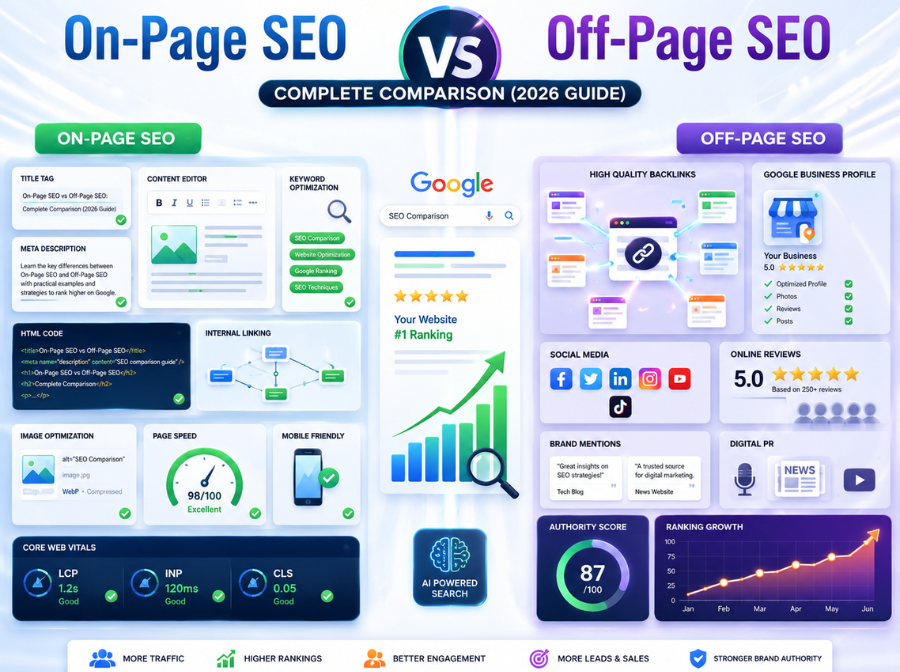
On-Page SEO vs Off-Page SEO
| Feature | On-Page SEO | Off-Page SEO |
|---|---|---|
| Location | On your website | Outside your website |
| Focus | Content & technical optimization | Website authority |
| Control | Full control | Limited control |
| Main Goal | Improve relevance | Build trust |
| Keywords | Yes | Indirect |
| Backlinks | No | Yes |
| Content Optimization | Yes | No |
| Technical SEO | Yes | No |
| Brand Authority | Limited | High |
| Time to Results | Faster | Takes longer |
Which is More Important?
The answer is both.
Imagine building a house.
- On-Page SEO is the strong foundation.
- Off-Page SEO is your reputation in the neighborhood.
Without good content, backlinks won’t help much. Without authority, even excellent content may struggle to rank for competitive keywords.
The best SEO strategy combines both.
Best On-Page SEO Checklist (2026)
✅ Keyword research
✅ SEO-friendly URL
✅ Optimized title tag
✅ Meta description
✅ H1 heading
✅ Internal links
✅ External references
✅ Image optimization
✅ Fast loading speed
✅ Mobile-friendly design
✅ Structured data
✅ Helpful content
✅ Clear call-to-action
Best Off-Page SEO Checklist (2026)
✅ Quality backlinks
✅ Guest posting
✅ Google Business Profile optimization
✅ Local citations
✅ Social media marketing
✅ Online reviews
✅ Digital PR
✅ Brand mentions
✅ Forum participation
✅ Influencer collaborations
Common SEO Mistakes
Avoid these common errors:
- Keyword stuffing
- Buying backlinks
- Duplicate content
- Slow website speed
- Ignoring mobile users
- Broken links
- Thin content
- Poor navigation
- Missing meta descriptions
- Low-quality backlinks
Future of SEO in 2026
Google increasingly prioritizes:
- AI-assisted search experiences
- Helpful, people-first content
- User experience (UX)
- Core Web Vitals
- E-E-A-T (Experience, Expertise, Authoritativeness, Trustworthiness)
- Semantic search
- Voice search optimization
- Local SEO
- Structured data
- Brand authority
Businesses that consistently publish valuable content while earning genuine mentions and backlinks are better positioned for long-term rankings.
Final Thoughts
The debate between On-Page SEO vs Off-Page SEO isn’t about choosing one over the other. Both play a critical role in improving your website’s visibility on search engines.
On-Page SEO ensures your website is optimized, user-friendly, and relevant to search intent. Off-Page SEO builds credibility through backlinks, brand mentions, reviews, and digital authority. When combined with technical SEO and high-quality content, these strategies create a solid foundation for sustainable organic growth.
If you’re aiming to rank higher in Google in 2026, focus on creating exceptional content, optimizing every page, improving user experience, and building trustworthy relationships across the web. A balanced SEO strategy will consistently outperform relying on just one aspect of optimization.
Frequently Asked Questions (FAQs)
1. What is the main difference between On-Page SEO and Off-Page SEO?
On-Page SEO focuses on optimizing elements within your website, while Off-Page SEO improves your site’s authority through external factors like backlinks and brand mentions.
2. Is On-Page SEO enough to rank on Google?
For low-competition keywords, strong On-Page SEO may be enough. For competitive keywords, Off-Page SEO is usually essential.
3. Which is easier to control?
On-Page SEO is fully under your control, whereas Off-Page SEO depends on external websites and your online reputation.
4. How long does Off-Page SEO take to show results?
Building authority through backlinks and mentions often takes several months, depending on your industry and competition.
5. Should small businesses invest in both?
Yes. A combination of well-optimized pages and consistent authority-building efforts provides the best long-term SEO results.
Recent Comments
Category
- Digital Marketing(52)
- Shopify(17)
- Web Design(17)