Compare Shared Hosting, VPS Hosting, and Cloud Hosting. Learn their pros, cons, pricing, performance, and choose the best hosting
Shared Hosting vs VPS vs Cloud Hosting – Which is Best?
- Home
- Shared Hosting vs VPS vs Cloud Hosting – Which is Best?
Digital Marketing
 By Abhilasha Hayaran
July 09, 2026
By Abhilasha Hayaran
July 09, 2026
Shared Hosting vs VPS vs Cloud Hosting – Which is Best?
By Abhilasha Hayaran
July 09, 2026
Choosing the right web hosting is one of the most important decisions for your website. Whether you’re launching a personal blog, a business website, an online store, or a corporate portal, your hosting directly affects your website’s speed, security, uptime, and overall performance.
Many beginners get confused when choosing between Shared Hosting vs VPS vs Cloud Hosting. While all three hosting types can host websites, each serves a different purpose depending on your website’s traffic, budget, and technical requirements.
In this complete website hosting comparison, we’ll explain how each hosting type works, its advantages, disadvantages, pricing, and help you choose the best hosting for your business.
What is Shared Hosting?
Shared Hosting is the most affordable hosting solution where multiple websites share the same server resources such as CPU, RAM, storage, and bandwidth.
Think of it like renting one apartment with several roommates. Everyone shares the available resources.
It is the perfect option for:
- Personal blogs
- Portfolio websites
- Startup businesses
- Small company websites
- Students learning WordPress
Advantages of Shared Hosting
- Lowest hosting cost
- Beginner-friendly
- Easy control panel
- One-click WordPress installation
- Maintenance handled by hosting provider
Disadvantages
- Limited performance
- Slower during traffic spikes
- Shared server resources
- Limited customization
- Lower security than VPS or Cloud
If you’re starting your first website, Shared Hosting is usually enough.
What is VPS Hosting?
VPS stands for Virtual Private Server.
A physical server is divided into multiple virtual servers. Unlike Shared Hosting, every VPS gets dedicated resources.
Imagine living in your own apartment within a building. You have your own space and resources while still sharing the building infrastructure.
VPS Hosting is suitable for:
- Growing businesses
- Medium traffic websites
- WooCommerce stores
- Business portals
- Agency websites
Advantages of VPS Hosting
- Better speed
- Dedicated RAM and CPU
- Improved security
- Root server access
- Scalable resources
- Better uptime
Disadvantages
- Higher cost
- Requires some technical knowledge
- Server management responsibilities
VPS is ideal for websites receiving thousands of visitors every month.
What is Cloud Hosting?
Cloud Hosting uses multiple connected servers instead of a single physical server.
Your website resources are distributed across several servers. If one server fails, another instantly takes over.
This provides exceptional uptime and reliability.
Cloud Hosting is ideal for:
- eCommerce websites
- SaaS platforms
- High traffic blogs
- Enterprise businesses
- Large corporate websites
Advantages of Cloud Hosting
- Excellent uptime
- High performance
- Automatic scaling
- Better disaster recovery
- Pay for resources you use
- Handles sudden traffic spikes
Disadvantages
- Higher pricing
- Slightly complex setup
- Variable monthly costs depending on usage
Cloud Hosting is considered the future of website hosting because of its flexibility and scalability.
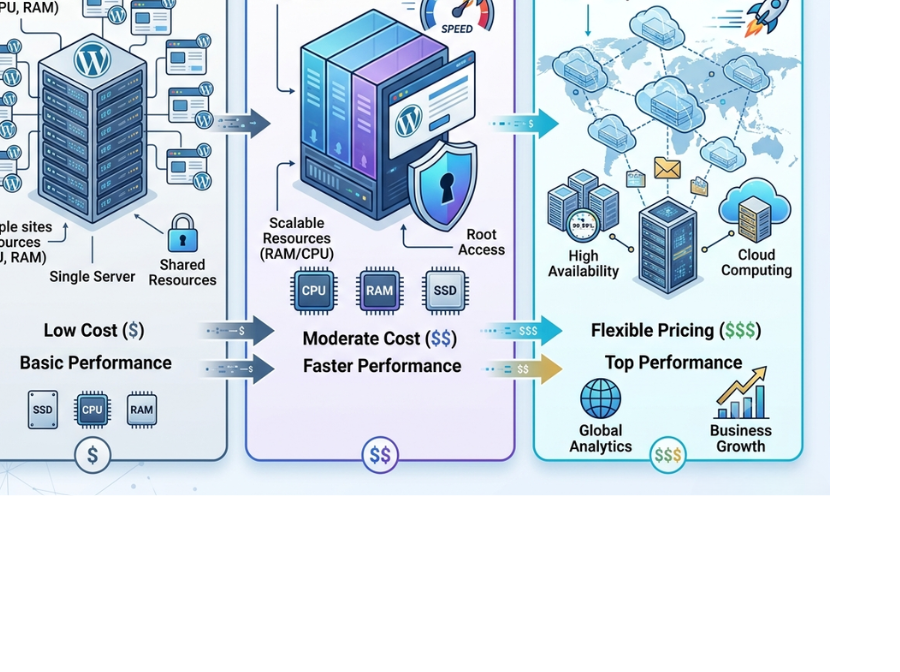
Shared Hosting vs VPS vs Cloud Hosting Comparison
| Feature | Shared Hosting | VPS Hosting | Cloud Hosting |
|---|---|---|---|
| Cost | Lowest | Medium | Higher |
| Performance | Basic | Good | Excellent |
| Speed | Average | Fast | Very Fast |
| Security | Basic | Better | Advanced |
| Scalability | Limited | Moderate | Excellent |
| Server Resources | Shared | Dedicated | Dynamic |
| Uptime | Good | Better | Best |
| Best For | Beginners | Growing Business | High Traffic Websites |
Which Hosting is Best for WordPress?
If you’re building a WordPress website, your hosting choice depends on your goals.
Shared Hosting
Best for:
- New blogs
- Small business websites
- Personal portfolios
- Local businesses
VPS Hosting
Perfect for:
- WooCommerce stores
- Agency websites
- Membership websites
- Growing businesses
Cloud Hosting
Recommended for:
- Large eCommerce stores
- High-traffic blogs
- SaaS applications
- Enterprise websites
- Businesses expecting rapid growth
How Much Does Hosting Cost?
Approximate yearly pricing in India:
Shared Hosting
₹1,500 – ₹4,000/year
VPS Hosting
₹8,000 – ₹30,000/year
Cloud Hosting
₹10,000 – ₹1,00,000+/year depending on usage
Although Shared Hosting is cheaper, upgrading to VPS or Cloud Hosting becomes worthwhile as your website grows.
Factors to Consider Before Choosing Hosting
Before purchasing any hosting plan, consider these factors:
Website Traffic
Higher traffic requires better resources.
Website Type
A blog has different requirements than an online store.
Budget
Choose hosting that balances performance and affordability.
Scalability
Your hosting should support future growth without major migration issues.
Security
Look for SSL certificates, malware scanning, backups, and firewalls.
Customer Support
Choose a hosting provider offering 24/7 technical support.
Which Hosting Should You Choose?
Choose Shared Hosting if:
- You’re launching your first website.
- You have a limited budget.
- Your traffic is below 10,000 monthly visitors.
Choose VPS Hosting if:
- Your business is growing.
- You need faster loading speeds.
- You run a WooCommerce store.
- You need more control over your server.
Choose Cloud Hosting if:
- Your website receives heavy traffic.
- Downtime is unacceptable.
- You expect rapid growth.
- Performance and scalability are top priorities.
Final Verdict
When comparing Shared Hosting vs VPS vs Cloud Hosting, there is no one-size-fits-all solution.
Shared Hosting is affordable and perfect for beginners. VPS Hosting provides better speed, security, and dedicated resources for growing businesses. Cloud Hosting delivers maximum performance, scalability, and reliability for websites with high traffic and demanding workloads.
If you’re just starting your online journey, Shared Hosting offers excellent value. As your website grows, upgrading to VPS Hosting ensures better performance. For businesses handling large volumes of visitors or mission-critical applications, Cloud Hosting is the most future-ready choice.
Choosing the right hosting today lays the foundation for a faster, more secure, and more successful website tomorrow.
FAQs
Is Shared Hosting good for WordPress?
Yes. Shared Hosting is ideal for small WordPress websites, blogs, and startup businesses with low to moderate traffic.
Is VPS faster than Shared Hosting?
Yes. VPS Hosting provides dedicated resources, resulting in better speed, stability, and performance than Shared Hosting.
Is Cloud Hosting worth the cost?
If your website experiences high traffic, requires maximum uptime, or needs to scale quickly, Cloud Hosting is a worthwhile investment.
Which hosting is best for a business website?
For most small and growing businesses, VPS Hosting offers the best balance of performance, security, and cost. Large businesses with heavy traffic benefit most from Cloud Hosting.
Recent Comments
Category
- Digital Marketing(52)
- Shopify(17)
- Web Design(17)