Discover 10 proven SEO strategies to improve Google rankings, increase organic traffic, and grow your business. Learn keyword
10 Proven SEO Strategies to Rank Your Website on Google
- Home
- 10 Proven SEO Strategies to Rank Your Website on Google
Digital Marketing
 By Abhilasha Hayaran
July 17, 2026
By Abhilasha Hayaran
July 17, 2026
10 Proven SEO Strategies to Rank Your Website on Google
By Abhilasha Hayaran
July 17, 2026
Ranking on Google has become more competitive than ever. With Google’s AI-powered search experience, helpful content updates, and evolving ranking algorithms, businesses need a smarter SEO strategy instead of relying on outdated tricks.
Whether you’re a small business owner, blogger, or eCommerce store, following proven SEO strategies can significantly improve your website’s visibility, organic traffic, and conversions.
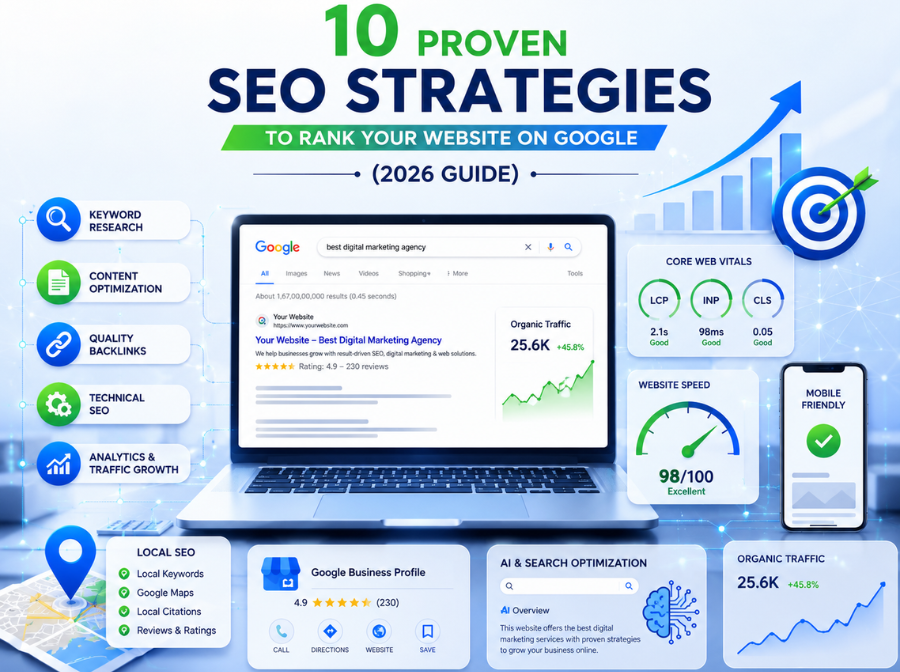
In this comprehensive guide, you’ll learn 10 SEO strategies that continue to deliver results in 2026.
1. Perform Smart Keyword Research
Everything starts with choosing the right keywords.
Instead of targeting highly competitive keywords, focus on search intent and long-tail keywords that your audience actually searches for.
Best Keyword Research Tips
- Use Google Autocomplete
- Analyze competitor keywords
- Target long-tail keywords
- Focus on buyer intent
- Use question-based keywords
Example
Instead of:
Website Design
Target:
- Affordable Website Design Company
- Website Design for Small Business
- Website Design Services Near Me
Using the right keywords improves your chances of ranking faster while attracting highly relevant visitors.
2. Create Helpful, High-Quality Content
Google rewards content that genuinely helps users.
Rather than writing articles filled with keywords, answer your audience’s questions in detail.
Your content should:
- Solve real problems
- Include practical examples
- Stay updated
- Be easy to read
- Provide actionable advice
Long-form content between 1,200–2,500 words often performs better because it covers topics comprehensively.
3. Optimize Every Page with On-Page SEO
On-page SEO helps Google understand your content.
Optimize
- SEO Title
- Meta Description
- URL Structure
- H1 Heading
- H2 & H3 Headings
- Internal Links
- Image Alt Text
- Keyword Placement
Use your primary keyword naturally in:
- Title
- First paragraph
- One H2 heading
- Meta description
- Image alt text
- Conclusion
Avoid keyword stuffing.
4. Improve Website Speed
Website speed is one of Google’s official ranking factors.
A slow website increases bounce rates and lowers rankings.
Speed Optimization Tips
- Compress images
- Enable browser caching
- Use a CDN
- Choose fast hosting
- Minify CSS & JavaScript
- Remove unused plugins
A website that loads in under 2 seconds usually provides a much better user experience.
5. Focus on Core Web Vitals
Google measures user experience through Core Web Vitals.
The three important metrics are:
- Largest Contentful Paint (LCP)
- Interaction to Next Paint (INP)
- Cumulative Layout Shift (CLS)
Improving these metrics can positively impact both rankings and user satisfaction.
6. Build High-Quality Backlinks
Backlinks remain one of the strongest ranking signals.
However, quality matters far more than quantity.
Proven Link Building Methods
- Guest blogging
- Digital PR
- Resource pages
- Business directories
- Industry partnerships
- Link-worthy content
- Case studies
- Original research
Avoid buying spammy backlinks because they can lead to ranking penalties.
7. Optimize for Local SEO
If your business serves a local area, Local SEO is essential.
Local SEO Checklist
- Optimize your Google Business Profile
- Collect customer reviews
- Add local keywords
- Build local citations
- Use consistent NAP details
- Create location-specific pages
Example:
Instead of
SEO Agency
Use
SEO Agency in Gwalior
This helps you rank for location-based searches like “SEO agency near me.”
8. Make Your Website Mobile-Friendly
More than half of Google searches happen on mobile devices.
Your website should:
- Load quickly
- Be responsive
- Have readable fonts
- Use clickable buttons
- Avoid intrusive pop-ups
Google uses mobile-first indexing, meaning it primarily evaluates the mobile version of your site.
9. Strengthen Internal Linking
Internal links help users discover related content and help search engines understand your site’s structure.
Example:
A blog on Website Speed can link to:
- Web Hosting Guide
- Technical SEO Checklist
- Core Web Vitals Guide
- SEO Audit Guide
Benefits include:
- Better crawling
- Higher engagement
- Improved rankings
- Increased page authority
10. Regularly Update Existing Content
SEO is an ongoing process.
Google prefers fresh, accurate, and updated content.
Every few months:
- Update statistics
- Refresh screenshots
- Improve readability
- Add FAQs
- Include new keywords
- Fix broken links
- Expand thin sections
Refreshing older articles can often boost rankings without creating entirely new content.
Bonus SEO Tips for 2026
To stay ahead of competitors:
- Publish content consistently
- Use schema markup
- Optimize images
- Add FAQ sections
- Improve user experience
- Reduce bounce rate
- Monitor rankings regularly
- Track conversions with analytics
- Focus on E-E-A-T (Experience, Expertise, Authoritativeness, and Trustworthiness)
Common SEO Mistakes to Avoid
Many websites struggle because of avoidable mistakes:
- Keyword stuffing
- Duplicate content
- Slow website speed
- Poor mobile optimization
- Missing meta descriptions
- Broken links
- Thin content
- Ignoring search intent
- Low-quality backlinks
- Infrequent content updates
Fixing these issues can significantly improve your SEO performance.
Final Thoughts
SEO success doesn’t happen overnight, but implementing these 10 proven SEO strategies will help your website achieve better Google rankings, attract more qualified visitors, and generate sustainable organic traffic over time.
Start by focusing on keyword research, creating valuable content, improving technical performance, optimizing for mobile users, and building authoritative backlinks. Combine these efforts with regular updates and a strong user experience, and you’ll be well-positioned for long-term growth in search results.
Remember, SEO is a marathon—not a sprint. Consistency and quality are the keys to lasting success.
FAQs
How long does SEO take to show results?
Most websites see noticeable improvements within 3–6 months, depending on competition, website authority, and consistency.
Is SEO better than Google Ads?
SEO provides long-term organic traffic, while Google Ads can deliver immediate visibility. A balanced digital marketing strategy often includes both.
What is the most important Google ranking factor?
There isn’t a single factor. High-quality content, relevant keywords, page experience, backlinks, and search intent all play major roles.
Can small businesses rank on Google?
Yes. By targeting local keywords, optimizing their Google Business Profile, and publishing valuable content, small businesses can compete effectively.
Recent Comments
Category
- Digital Marketing(52)
- Shopify(17)
- Web Design(17)