Compare SEO vs Google Ads to discover which marketing strategy is best for your business. Learn the pros, cons, costs, ROI, and
SEO vs Google Ads – Which One is Better for Your Business?
- Home
- SEO vs Google Ads – Which One is Better for Your Business?
Digital Marketing
 By Abhilasha Hayaran
July 16, 2026
By Abhilasha Hayaran
July 16, 2026
SEO vs Google Ads – Which One is Better for Your Business?
By Abhilasha Hayaran
July 16, 2026
If you want more customers online, you’ve probably wondered whether to invest in SEO or Google Ads. Both are powerful digital marketing strategies, but they work in very different ways.
One focuses on earning long-term organic traffic, while the other delivers instant visibility through paid advertising. Choosing the right strategy depends on your business goals, budget, competition, and timeline.
In this guide, we’ll compare SEO vs Google Ads, their advantages, disadvantages, costs, and explain which option is best for different types of businesses.
What is SEO?
Search Engine Optimization (SEO) is the process of improving your website so it ranks higher in Google’s organic search results.
SEO includes:
- Keyword research
- High-quality content creation
- Technical SEO
- Website speed optimization
- Mobile responsiveness
- Link building
- Local SEO
- User experience improvements
Unlike paid advertising, you don’t pay Google for every visitor. Instead, you earn traffic by providing valuable, optimized content.
Benefits of SEO
- Long-term traffic
- Higher trust among users
- Better brand authority
- Cost-effective over time
- Consistent lead generation
- Better user experience
- Higher ROI in the long run
What is Google Ads?
Google Ads is Google’s Pay-Per-Click (PPC) advertising platform where businesses pay to appear at the top of search results.
Every time someone clicks your ad, you pay a certain amount known as Cost Per Click (CPC).
Google Ads allows businesses to target users based on:
- Keywords
- Location
- Age
- Interests
- Device
- Time
- Audience behavior
Ads can appear on:
- Google Search
- YouTube
- Gmail
- Google Display Network
- Shopping Results
- Google Maps
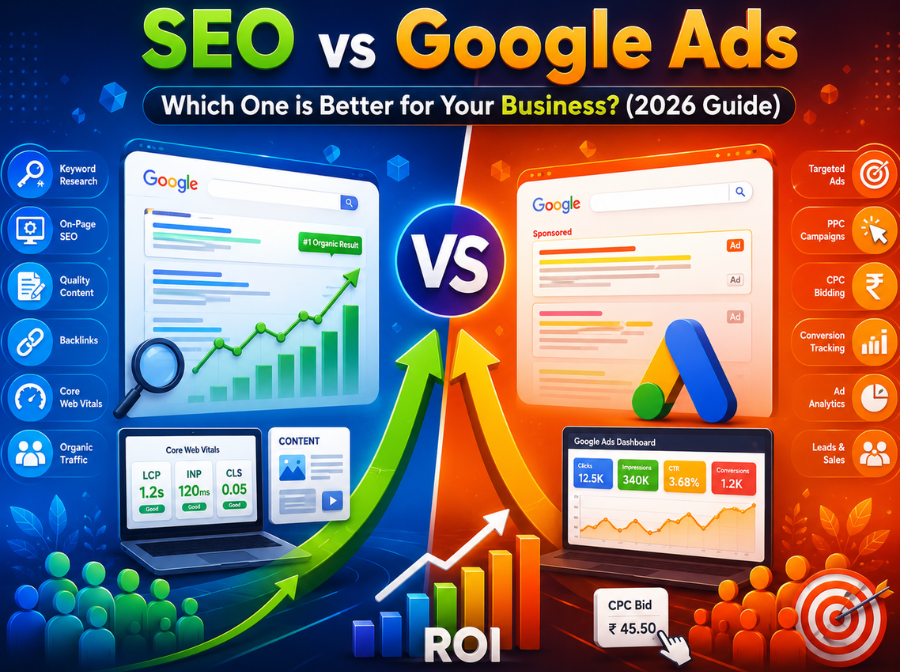
SEO vs Google Ads: Key Differences
| Feature | SEO | Google Ads |
|---|---|---|
| Cost | Free organic clicks | Pay per click |
| Results | Long-term | Immediate |
| Traffic | Organic | Paid |
| Trust | Higher | Moderate |
| Sustainability | Excellent | Stops when budget ends |
| Competition | Content quality | Bid amount + Quality Score |
| ROI | High over time | Fast but ongoing cost |
| Best For | Long-term growth | Instant leads |
Advantages of SEO
1. Long-Term Results
Once your website ranks well, it can continue generating traffic for months or even years with regular updates.
2. Higher Credibility
Most users trust organic search results more than paid advertisements.
Studies consistently show that users often skip ads and click on organic listings.
3. Better ROI
Although SEO takes time, the cost per lead usually decreases over time because you don’t pay for every click.
4. Builds Brand Authority
Publishing helpful content establishes your business as an industry expert.
Blogs, guides, FAQs, and case studies all improve authority.
5. Continuous Lead Generation
Your website works 24/7, bringing in potential customers without additional advertising costs.
Advantages of Google Ads
Instant Visibility
Google Ads can place your website at the top of search results within hours.
This is ideal for:
- New businesses
- Product launches
- Seasonal offers
- Flash sales
Highly Targeted Audience
You can show ads only to people searching for your services.
Example:
A web design company in Gwalior can target:
- Website designer near me
- Website development company
- Web developer in Gwalior
Easy Performance Tracking
Google Ads provides detailed reports including:
- Clicks
- Impressions
- CTR
- Conversions
- Cost per lead
- ROI
This makes campaign optimization easier.
Flexible Budget
Businesses can start with as little as ₹500 per day and scale campaigns based on results.
Disadvantages of SEO
SEO isn’t perfect.
Some limitations include:
- Takes 3–6 months for noticeable results
- Requires continuous content creation
- Algorithm updates may affect rankings
- High competition in popular industries
However, once rankings improve, the long-term benefits are significant.
Disadvantages of Google Ads
Google Ads also has drawbacks.
These include:
- Continuous spending
- Rising CPC in competitive markets
- Stops generating traffic when budget ends
- Requires ongoing optimization
- Can become expensive for small businesses
Which One Costs More?
SEO Investment
SEO usually involves:
- Website optimization
- Content writing
- Technical improvements
- Link building
- Monthly maintenance
Although the initial investment may seem higher, the long-term cost per lead is generally lower.
Google Ads Investment
Google Ads costs depend on:
- Industry
- Competition
- Keyword CPC
- Campaign quality
- Target audience
Highly competitive industries like legal, finance, healthcare, and insurance often have much higher click costs.
When Should You Choose SEO?
SEO is ideal if you want:
- Long-term business growth
- Organic website traffic
- Better search rankings
- Brand authority
- Sustainable lead generation
- Lower marketing costs over time
Perfect for:
- Local businesses
- Service providers
- Bloggers
- Educational websites
- Agencies
- E-commerce stores
When Should You Choose Google Ads?
Google Ads works best if you need:
- Immediate leads
- Fast website traffic
- Product launches
- Event promotions
- Seasonal campaigns
- Limited-time offers
Ideal for:
- New businesses
- Startups
- E-commerce stores
- Real estate
- Healthcare
- Education
- SaaS companies
The Best Strategy: Combine SEO and Google Ads
The most successful businesses don’t choose one—they use both.
A balanced strategy could look like this:
- Use Google Ads to generate immediate traffic and leads.
- Invest in SEO to build long-term organic visibility.
- Use SEO insights to improve ad targeting.
- Use Google Ads data to identify high-converting keywords for future SEO content.
This combination provides both short-term wins and sustainable growth.
Final Verdict
So, SEO vs Google Ads—which is better?
The answer depends on your goals.
If you need immediate visibility, quick leads, and fast results, Google Ads is the better option.
If you’re focused on long-term growth, lower customer acquisition costs, and building lasting online authority, SEO is the smarter investment.
For most businesses, the ideal approach is to combine both strategies. Google Ads can deliver instant traffic while SEO builds a strong foundation that continues generating leads long after your ad spend ends. By using them together, you maximize visibility, improve conversions, and create a sustainable digital marketing strategy for long-term success.
FAQs
Is SEO better than Google Ads?
SEO is better for long-term growth and organic traffic, while Google Ads is better for immediate visibility and quick lead generation.
Can I use SEO and Google Ads together?
Yes. Combining SEO and Google Ads helps you capture both organic and paid traffic, maximizing your online presence.
Which is cheaper?
SEO generally becomes more cost-effective over time because you don’t pay for each click. Google Ads requires continuous spending to maintain traffic.
How long does SEO take?
SEO typically takes 3–6 months to show significant improvements, depending on your industry, competition, and website quality.
Is Google Ads worth it for small businesses?
Yes. Google Ads can be highly effective for small businesses seeking immediate leads, especially when campaigns are well-targeted and optimized.
Recent Comments
Category
- Digital Marketing(52)
- Shopify(17)
- Web Design(17)