Compare WordPress, Shopify, and custom websites to find the best platform for your business. Learn about costs, features, SEO,
WordPress vs Shopify vs Custom Website – Which One Should You Choose?
- Home
- WordPress vs Shopify vs Custom Website – Which One Should You Choose?
Digital Marketing
 By Abhilasha Hayaran
July 07, 2026
By Abhilasha Hayaran
July 07, 2026
WordPress vs Shopify vs Custom Website – Which One Should You Choose?
By Abhilasha Hayaran
July 07, 2026
Choosing the right platform for your business website is one of the most important decisions you’ll make when building your online presence. Whether you’re launching a small business website, an eCommerce store, or a custom web application, selecting the right platform can significantly impact your success.
The three most popular options available today are WordPress, Shopify, and Custom Website Development. Each platform offers unique advantages and disadvantages depending on your business goals, budget, technical expertise, and future growth plans.
In this guide, we’ll compare WordPress vs Shopify vs Custom Website development to help you decide which solution is best for your business.
Why Choosing the Right Website Platform Matters
Your website is more than just an online brochure. It’s your digital storefront, marketing tool, lead generation machine, and customer service platform.
Choosing the wrong platform can lead to:
- Higher maintenance costs
- Poor SEO performance
- Limited customization options
- Slow website speed
- Difficulty scaling your business
- Expensive redesigns in the future
That’s why understanding the strengths and weaknesses of each platform is essential.
What Is WordPress?
WordPress is the world’s most popular content management system (CMS), powering over 40% of all websites globally. It is an open-source platform that allows businesses to create websites, blogs, portfolios, and online stores.
Advantages of WordPress
1. Affordable Website Development
WordPress websites are generally less expensive to build compared to custom websites.
2. SEO-Friendly Platform
WordPress offers excellent SEO capabilities with plugins like Yoast SEO and Rank Math.
3. Highly Customizable
Thousands of themes and plugins allow you to customize your website without coding.
4. Easy Content Management
You can easily update blogs, pages, images, and products without technical knowledge.
5. Large Community Support
Millions of developers and users provide extensive support and resources.
Disadvantages of WordPress
- Requires regular maintenance
- Plugin conflicts may occur
- Security depends on proper management
- Performance optimization is necessary
Best For:
- Small businesses
- Service providers
- Blogs
- Corporate websites
- Portfolio websites
- SEO-focused businesses
What Is Shopify?
Shopify is a hosted eCommerce platform designed specifically for selling products online. It provides everything needed to run an online store, including hosting, payment gateways, inventory management, and security.
Advantages of Shopify
1. Easy Setup
You can launch an online store quickly without technical expertise.
2. Built-In Hosting and Security
Shopify handles hosting, backups, SSL certificates, and updates.
3. Excellent eCommerce Features
Features include:
- Inventory management
- Product variations
- Payment gateways
- Shipping integration
- Order management
- Customer accounts
4. Mobile-Friendly Design
Most Shopify themes are responsive and optimized for mobile users.
5. Reliable Performance
Shopify manages server optimization and website speed.
Disadvantages of Shopify
- Monthly subscription fees
- Transaction fees on some plans
- Limited customization compared to WordPress
- Higher long-term costs
- Restricted control over server settings
Best For:
- Online stores
- Dropshipping businesses
- Fashion brands
- Product-based businesses
- Startups launching eCommerce websites
What Is a Custom Website?
A custom website is built from scratch using programming languages and frameworks such as HTML, CSS, JavaScript, PHP, Laravel, React, Node.js, or Python.
Unlike WordPress or Shopify, custom development provides complete control over design, functionality, and user experience.
Advantages of Custom Websites
1. Unlimited Customization
You can build exactly what your business requires.
2. Better Performance Optimization
Custom coding eliminates unnecessary features and improves speed.
3. Enhanced Security
Custom-built systems can provide stronger security measures.
4. Scalability
Custom websites can grow alongside your business requirements.
5. Unique User Experience
You can create a completely personalized customer experience.
Disadvantages of Custom Websites
- High development costs
- Longer development time
- Requires professional developers
- More expensive maintenance
- Complex updates and support
Best For:
- Enterprise businesses
- SaaS platforms
- Marketplaces
- Large eCommerce stores
- Startups with unique requirements
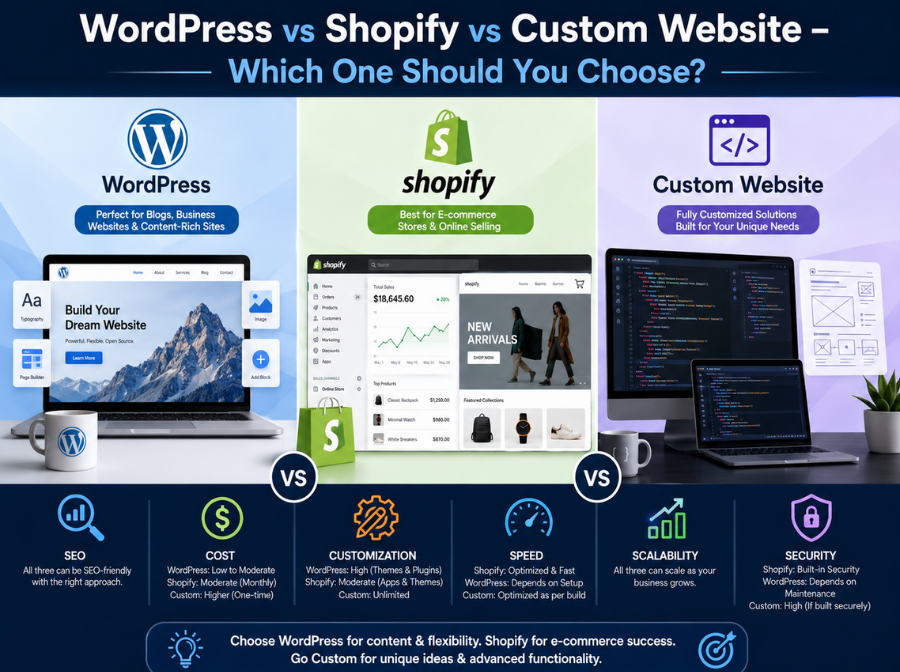
WordPress vs Shopify vs Custom Website Comparison
| Feature | WordPress | Shopify | Custom Website |
|---|---|---|---|
| Initial Cost | Low | Medium | High |
| Monthly Cost | Low | Medium-High | Variable |
| SEO | Excellent | Good | Excellent |
| Customization | Very High | Moderate | Unlimited |
| Ease of Use | Easy | Very Easy | Complex |
| eCommerce | Excellent (WooCommerce) | Excellent | Custom |
| Scalability | High | High | Unlimited |
| Maintenance | Required | Minimal | Developer Required |
| Development Time | Fast | Very Fast | Long |
| Performance | Good | Excellent | Excellent |
Which Platform Is Best for SEO?
If SEO is your priority, both WordPress and custom websites perform exceptionally well.
WordPress SEO Advantages:
- SEO plugins
- Custom URLs
- Meta tag control
- Blogging capabilities
- Schema support
- XML sitemaps
Shopify SEO Advantages:
- Clean architecture
- Fast loading speed
- Mobile optimization
Custom Website SEO Advantages:
- Complete optimization control
- Faster performance
- Advanced technical SEO implementation
For most businesses, WordPress provides the best balance between SEO flexibility and affordability.
Which Platform Is Best for Small Businesses?
For small businesses and startups, WordPress is often the best choice because it offers:
- Affordable development
- Easy management
- Excellent SEO
- Flexible customization
- Blogging features
- Scalability
If your primary goal is selling products online, Shopify may be the better option.
Which Platform Is Best for eCommerce?
Choose Shopify If:
- You only want to sell products online.
- You don’t want to manage hosting or security.
- You need a quick launch.
Choose WordPress + WooCommerce If:
- You want complete control.
- SEO is important.
- You need advanced customization.
- You want lower long-term costs.
Choose Custom Development If:
- You need marketplace features.
- You require custom workflows.
- You expect large-scale growth.
Cost Comparison
WordPress Website
- Domain: $10–20/year
- Hosting: $50–200/year
- Development: $300–3000
- Maintenance: $10–100/month
Shopify Website
- Subscription: $29–299/month
- Apps: $10–200/month
- Development: $500–5000
Custom Website
- Development: $2000–50000+
- Hosting: Variable
Maintenance: $100–1000/month
Which Platform Should You Choose?
Choose WordPress if:
✔ You want affordability
✔ SEO matters
✔ You need flexibility
✔ You want to manage content easily
Choose Shopify if:
✔ You want to sell products online
✔ You prefer an all-in-one solution
✔ You need quick setup
✔ You don’t want technical maintenance
Choose Custom Development if:
✔ You need unique functionality
✔ You have a large budget
✔ You expect significant growth
✔ You require complete control
Final Thoughts
There is no single “best” platform for every business. The right choice depends on your goals, budget, technical requirements, and future plans.
For most small and medium-sized businesses, WordPress offers the best combination of affordability, SEO performance, and flexibility.
For dedicated online stores, Shopify provides the easiest eCommerce experience.
For enterprises and businesses with unique requirements, custom website development offers unlimited possibilities.
Before making a decision, evaluate your long-term business goals and choose a platform that can grow with your company
Recent Comments
Category
- Digital Marketing(52)
- Shopify(17)
- Web Design(17)